
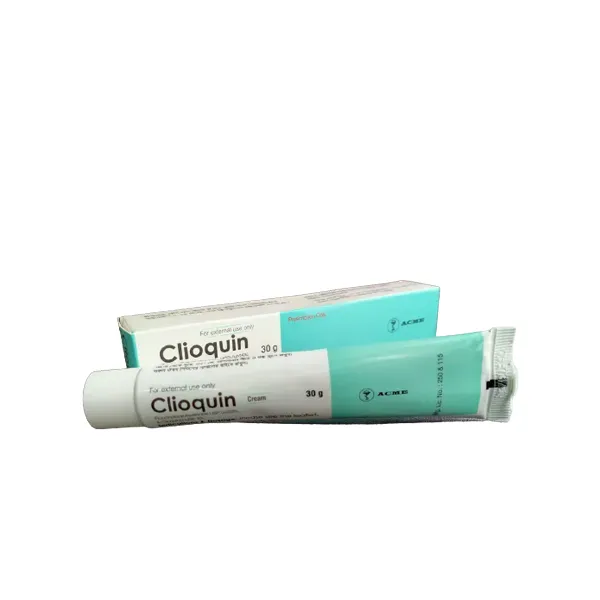
Clioquin 30gm
৳ 175
Therapeutic Class
Storage Conditions
Buy 15 products and get ৳ 20 discount
Description
Indications
Pharmacology
When fluocinolone is applied to the skin it works by acting inside the cells to decrease the release of these inflammatory substances. This reduces swelling, redness and itch.
There is a range of potencies of corticosteroids available for application to the skin. This medicine contains fluocinolone 0.025% and is classed as a potent corticosteroid. It is prescribed to treat various inflammatory skin disorders, such as eczema and dermatitis, that have not responded to milder steroids.
Clioquinol has antifungal and antibacterial actions. It works by preventing the growth and multiplication of the organisms.
The combination of fluocinolone and clioquinol is used to treat inflammatory skin disorders that are either infected or likely to become infected.
This cream is more suitable for moist, weeping areas of skin, while the thicker, more greasy ointment is more suitable for dry, scaly areas of skin.
Dosage & Administration
Interaction
If you are using other medicines on the same area of skin it is recommended that you leave several minutes between applying each product. This is to allow each product time to be absorbed and avoid them mixing on the skin.
If you apply moisturisers shortly before or after applying this medicine these can dilute the corticosteroid and potentially make it less effective. Try to apply your moisturisers at a different time of day, or at least 30 minutes before or after this one.
Contraindications
- Children under one year of age.
- Allergy to iodine.
- Primary bacterial skin infections, such as impetigo.
- Primary fungal skin infections such as thrush, ringworm, athlete’s foot.
- Viral skin infections, such as chickenpox, shingles, cold sores or herpes simplex.
- Acne.
- Chronic inflammatory disorder of the facial skin (acne rosacea).
- Inflammatory rash around the mouth (perioral dermatitis).
- Itching around the back passage and genitals.
- Nappy rash.
- Widespread plaque psoriasis.
Side Effects
- Skin irritation at site of application, such as burning, itching and redness.
- Allergic inflammation of the skin (contact dermatitis).
- Thinning of the skin.
- Changes in skin pigmentation.
- Stretch marks (striae).
- Groupings of fine blood vessels becoming prominent under the skin (telangiectasia).
Pregnancy & Lactation
This medicine should not be used during pregnancy unless considered essential by your doctor. If it is prescribed by your doctor it should not be used on large areas of skin, underneath airtight dressings, or for prolonged periods of time. Consult your doctor for further information.
This medicine should not be used during breastfeeding unless considered essential by your doctor. If it is prescribed by your doctor it should not be used on large areas of skin, underneath airtight dressings or for prolonged periods of time. If it is applied to the breasts it should be washed off carefully before breastfeeding and then reapplied afterwards.


Reviews
There are no reviews yet.