
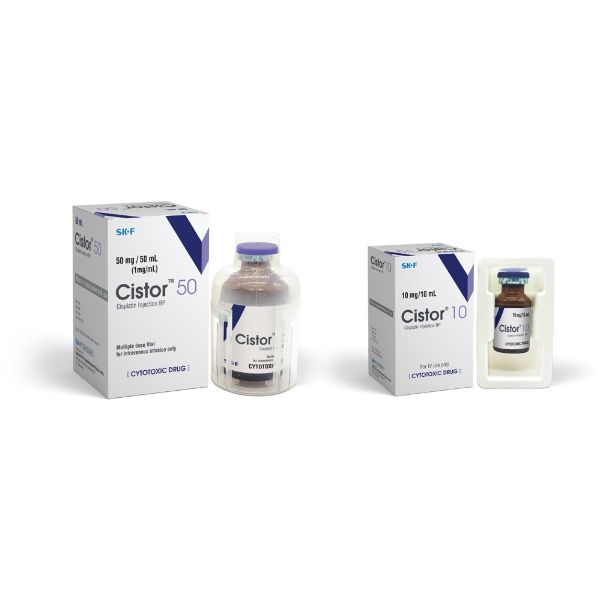
Cistor IV Infusion 10mg vial
৳ 300
Therapeutic Class
Storage Conditions
Buy 15 products and get ৳ 20 discount
Description
Indications
Metastatic Ovarian Tumors: In established combination therapy with other approved chemotherapeutic agents in patients with metastatic ovarian tumors who have already received appropriate surgical and/or radio therapeutic procedures. An established combination consists of Cistor and cyclophosphamide. Cistor, as a single agent, is indicated as secondary therapy in patients with metastatic ovarian tumors refractory to standard chemotherapy who have not previously received Cistor Injection therapy.
Advanced Bladder Cancer: Cistor is indicated as a single agent for patients with transitional cell bladder cancer which is no longer amenable to local treatments such as surgery and/or radiotherapy. Non
Small Cell Lung Carcinoma: Cistor in combination with other chemotherapeutic agent is indicated for the treatment of non small cell lung cancer in patients who are not candidates for potential curative surgery and/ or radiation therapy.
Pharmacology
Dosage & Administration
Metastatic Testicular Tumors: The usual Cisplatin Injection dose for the treatment of testicular cancer in combination with other approved chemotherapeutic agents is 20 mg/m2 IV daily for 5 days per cycle.
Metastatic Ovarian Tumors: The usual Cisplatin Injection dose for the treatment of metastatic ovarian tumors in combination with cyclophosphamide is 75 to 100 mg/m2 IV per cycle once every 4 weeks (DAY 1). The dose of cycloposphamide when used in combination with cisplatin is 600 mg/m2 IV once every four weeks (DAY 1). In combination therapy, Cisplatin Injection and cyclophosphamide are administered sequentially. As a single agent, Cisplatin Injection should be administered at a dose of 100 mg/m2 IV per cycle once every four weeks.
Advanced Bladder Cancer: Cisplatin Injection should be administered as a single agent at a dose of 50 to 70 mg/m2 IV per cycle once every 3 to 4 weeks depending on the extent of prior exposure to radiation therapy and/or prior chemotherapy. For heavily pretreated patients an initial dose of 50 mg/m2 per cycle repeated every 4 weeks is recommended.
Non Small Cell Lung Carcinoma: Cisplatin Injection (75 mg/m2) should be administered in combination with Paclitaxel (135 mg/m2) in every three weeks. Or, as directed by the registered physicians.
Interaction
Nephrotoxic drugs: Aminoglycoside antibiotics, when given concurrently or within 1-2 weeks after Cistor administration, may potentiate its nephrotoxic effects. Concomitant use of other potentially nephrotoxic drugs (eg Amphotericin B) is not recommended during Cistor therapy.
Ototoxic drugs: Concurrent and/or sequential administration of ototoxic drugs such as aminoglycoside antibiotics or loop diuretics may increase the potential of Cistor to cause ototoxicity, especially in the presence of renal impairment.
Renally excreted drugs: Cistor may alter the renal elimination of bleomycin and methotrexate (possibly as a result of Cistor-induced nephrotoxicity) and enhance their toxicity.
Anticonvulsant agents: In patients receiving Cistor and Phenytoin, serum concentrations of the latter may be decreased, possibly as a result of decreased absorption and/or increased metabolism. In these patients, serum levels of phenytoin should be monitored and dosage adjustments made as necessary.
Antigout agents: Cistor may raise the concentration of blood uric acid. Thus, in patients concurrently receiving antigout agents such as Allopurinol, Colchicine, Probenecid or Sulfinpyrazone, dosage adjustment of these drugs may be necessary to control hyperuricemia and gout.
Contraindications
Side Effects
Pregnancy & Lactation
Precautions & Warnings
Bone marrow function: Peripheral blood counts should be monitored frequently in patients receiving Cistor. Although the hematologic toxicity is usually moderate and reversible, severe thrombocytopenia and leukopenia may occur. In patients who develop thrombocytopenia special precautions are recommended: care in performing invasive procedures; search for signs of bleeding or bruising; test of urine, stools and emesis for occult blood; avoiding aspirin and other NSAIDs. Patients who develop leukopenia should be observed carefully for signs of infection and might require antibiotic support and blood product transfusions.
Hearing function: Cistor may produce cumulative ototoxicity, which is more likely to occur with high-dose regimens. Audiometry should be performed prior to initiating therapy, and repeated audiograms should be performed when auditory symptoms occur or clinical hearing changes become apparent. Clinically important deterioration of auditive function may require dosage modifications or discontinuation of therapy.
CNS functions: Cistor is known to induce neurotoxicity; therefore, neurologic examination is warranted in patients receiving a Cistor-containing treatment. Since neurotoxicity may result in irreversible damage, it is recommended to discontinue therapy with Cistor when neurologic toxic signs or symptoms become apparent. In addition, patients receiving Cistor should be observed for possible anaphylactoid reactions, and appropriate equipment and medication should be readily available to treat such reactions.
Nausea and Vomiting: Marked nausea and vomiting occur in almost all patients treated with Cistor and are occasionally so severe that dosage reduction or discontinuance of treatment is necessary. Cistor should be administered only by physicians experienced in the use of chemotherapeutic agents.
Carcinogenicity: Secondary malignancies are potential delayed effects of many antineoplastic agents, although it is not clear whether the effect is related to their mutagenic or immunosuppressive action. The effect of dose and duration of therapy is also unknown, although risk seems to increase with long-term use. Although information is limited, available data seems to indicate that the carcinogenic risk is greatest with the alkylating agents.
Dental: The bone marrow depressant effects of Cistor may result in an increased incidence of microbial infection,delayed healing, and gingival bleeding. Dental work, wherever possible, should be completed prior to initiation of therapy or deferred until blood counts have returned to normal.


Reviews
There are no reviews yet.