
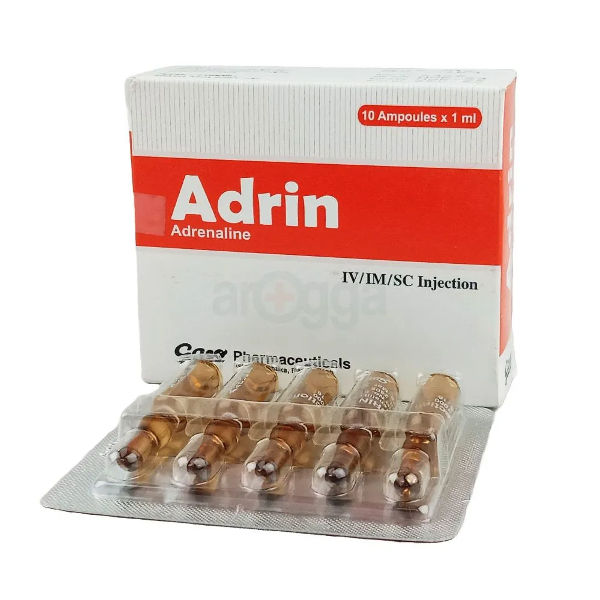
Adrin 1mg/ml
৳ 25
Interaction
Use of Adrin with excessive doses of digitalis, mercurial diuretics or other drugs that sensitize the heart to arrhythmias is not recommended. The adverse effects of Adrin may be potentiated by tricyclic antidepressants; certain antihistamines; e.g, Diphenhydramine, Tripelennamine, Chlorpheniramine and L-thyroxine Sodium.
Contraindications
Hypertension, arteriosclerosis, coronary disease and hyperthyroidism. Not to be given to patients taking monoamine oxidase inhibitors.
Side Effects
Common side effects are anxiety, restlessness, dizziness, headache, palpitations, rapid pulse, tremors, weakness and coldness of the extremities may be reported even with small doses and especially when given in conjunction with local anaesthetics.
Buy 15 products and get ৳ 20 discount
0 people are viewing this right now
Estimated Delivery : Up to 4 business days
Description
Indications
Adjunctive use in the management of cardiac arrest. It is used in cardiopulmonary resuscitation. Intracardiac puncture and intramyocardial injection of Adrin may be effective when external cardiac compression and attempts to restore the circulation by electrical defibrillation or use of a pacemaker fail. Adrin is a drug that leads to increased blood pressure, increased heart rate, increased air entry, increased blood glucose, stimulates cardiac activity and reduces allergic reactions by reducing inflammatory response caused by histamine. Due to these properties, it is used for the treatment of allergic and anaphylactic reactions. Adrin is the favored treatment for anaphylactic shock and should be administered immediately if a person begins exhibiting severe allergic reactions. Adrin is also used in life threatening asthma when failing ventilation and continued deterioration despite nebulizer therapy.
Description
Adrin is a direct-acting sympathomimetic agent exerting its effect on alpha and beta-adrenoceptors. The overall effect of Adrin depends on the dose, and may be complicated by the homeostatic reflex responses. In resuscitation procedures it is used to increase the efficacy of basic life support. It is a positive cardiac inotrope. Major effects are increased systolic blood pressure by arterioral and venous vasoconstriction (alpha1 effects), reduced diastolic pressure, tachycardia and hyperglycaemia. Adrin is rapid in onset and with short duration. After IV infusion the half-life is approximately 5-10 minutes. It is rapidly distributed to the heart, spleen, several glandular tissues and adrenergic nerves. Adrin is rapidly metabolised in the liver and tissues by oxidative de-amination and O- methylation followed by reduction or by conjugation with glucuronic acid or sulphate. Up to 90% of the IV dose is excreted in the urine as metabolites. It is approximately 50% bound to plasma proteins.
Pharmacology
The actions of epinephrine resemble the effects of stimulation of adrenergic nerves. It acts on both alpha and beta receptor sites of sympathetic effector cells. Its most prominent actions are on the beta receptors of the heart, vascular and other smooth muscle. When given by rapid intravenous injection, it produces a rapid rise in blood pressure, mainly systolic, by (1) direct stimulation of cardiac muscle which increases the strength of ventricular contraction, (2) increasing the heart rate and (3) constriction of the arterioles in the skin, mucosa and splanchnic areas of the circulation.
When given by slow intravenous injection, epinephrine usually produces only a moderate rise in systolic and a fall in diastolic pressure. Although some increase in pulse pressure occurs, there is usually no great elevation in mean blood pressure. Accordingly, the compensatory reflex mechanisms that come into play with a pronounced increase in blood pressure do not antagonize the direct cardiac actions of epinephrine as much as with catecholamines that have a predominant action on alpha receptors.
Dosage & Administration
Cardiac arrest:
- Intravenous injection: 1 mg injection repeated every 2-3 minutes as necessary.
- Endotracheal: 2-3 mg via an endotracheal tube, repeated as necessary.
- Intracardiac: 0.1 to 1 mg, direct into the atrium of the heart.
- Intraspinal: Usual dose is 0.2 to 0.4 mg added to anesthetic spinal fluid mixture (to prolong anesthetic action by limiting absorption).
Anaphylaxis, asthma or severe bronchospasm:
- Adult dose is 0.25 0.5 mg. It may be repeated at 5 minutes intervals until perfusion and respiratory status normalizes.
- In case of dose dilution: 1 mg of Adrenaline to be diluted in 9 ml Normal Saline.
Children: Initially 10 mcg/kg body weight, not to exceed 250 mcg. May be repeated every 3-5 minutes if necessary. Subsequent doses should be 100 mcg/kg.


Reviews
There are no reviews yet.