
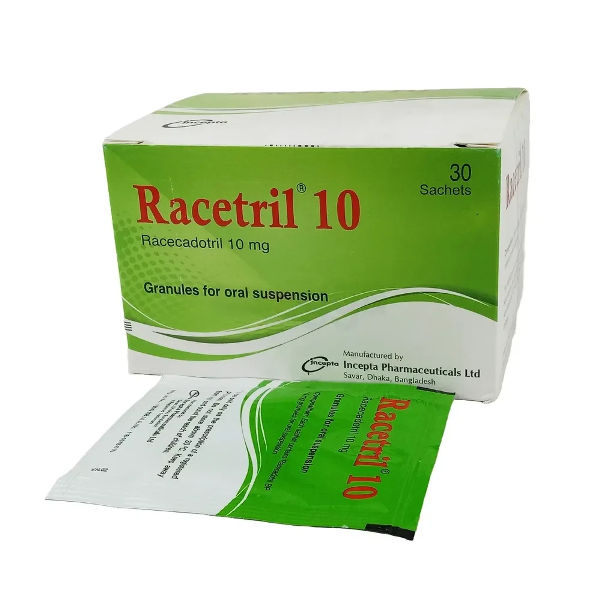
Racetril10 mg/sachet
Original price was: ৳ 7.৳ 6Current price is: ৳ 6.
Buy 15 products and get ৳ 20 discount
Description
Indications of Racetril 10 mg/sachet
Racetril 10 mg/sachet is indicated for the symptomatic treatment of acute diarrhea.
Theropeutic Class
Anti-diarrhoeal
Pharmacology
Racetril 10 mg/sachet increases the availability of endogenous opioids (enkephalins) by inhibiting the membrane-bound enkephalinase. The enkephalins in turn mediate their effect through ? receptor ( delta opioid receptor) activation that induces a selective increase in Cl absorption by inhibiting adenylate cyclase.Onset: 30 min (plasma enkephalinase inhibition).
Dosage & Administration of Racetril 10 mg/sachet
Adults: One capsule initially, regardless of the time of day. Then one capsule three times daily preferably before the main meals. Children (from 3 months of age): Racetril 10 mg/sachet granules should be administered together with oral rehydration. The recommended dose is determined according to body weight: 1.5 mg/kg per administration, three times daily. Infants less than 9 kg: one 10 mg sachet 3 times daily. Infants from 9 kg to 13 kg: two 10 mg sachets 3 times daily. Children from 13 kg to 27 kg: one 30mg sachet 3 times daily. Children of more than 27 kg: two 30mg sachets 3 times daily.
Dosage of Racetril 10 mg/sachet
Adults: One capsule initially, regardless of the time of day. Then one capsule three times daily preferably before the main meals. Children (from 3 months of age): Racetril 10 mg/sachet granules should be administered together with oral rehydration. The recommended dose is determined according to body weight: 1.5 mg/kg per administration, three times daily. Infants less than 9 kg: one 10 mg sachet 3 times daily. Infants from 9 kg to 13 kg: two 10 mg sachets 3 times daily. Children from 13 kg to 27 kg: one 30mg sachet 3 times daily. Children of more than 27 kg: two 30mg sachets 3 times daily.
Interaction of Racetril 10 mg/sachet
No drug interactions found. Joint treatment with Racetril 10 mg/sachet and Loperamide or Nifuroxazide does not modify the kinetics of Racetril 10 mg/sachet.
Contraindications
Hypersensitivity to Racetril 10 mg/sachet, or to any of the excipients.
Side Effects of Racetril 10 mg/sachet
Headache, erythema multiforme, urticaria, angioedema may be seen.
Pregnancy & Lactation
Due to a lack of clinical data, Racetril 10 mg/sachet should not be administered to pregnant or breastfeeding women.
Precautions & Warnings
The administration of Racetril 10 mg/sachet does not modify the usual rehydration regimens. The presence of bloody stools and fever may indicate the presence of invasive bacteria as a reason for diarrhea or the presence of other severe disease. Racetril 10 mg/sachet has not been tested in antibiotic-associated diarrhea and should therefore not be administered under these conditions. Caution should be taken in patients with renal or liver impairment.
Overdose Effects of Racetril 10 mg/sachet
No cases of overdose have been reported. In adults, single doses above 2 g which is equivalent to 20 times the therapeutic dose, have been administered, and no harmful effects have been described.
Drug Classes
Anti-diarrhoeal
Mode Of Action
Racetril 10 mg/sachet increases the availability of endogenous opioids (enkephalins) by inhibiting the membrane-bound enkephalinase. The enkephalins in turn mediate their effect through ? receptor ( delta opioid receptor) activation that induces a selective increase in Cl absorption by inhibiting adenylate cyclase.Onset: 30 min (plasma enkephalinase inhibition).
Pregnancy
Due to a lack of clinical data, Racetril 10 mg/sachet should not be administered to pregnant or breastfeeding women.


Reviews
There are no reviews yet.