
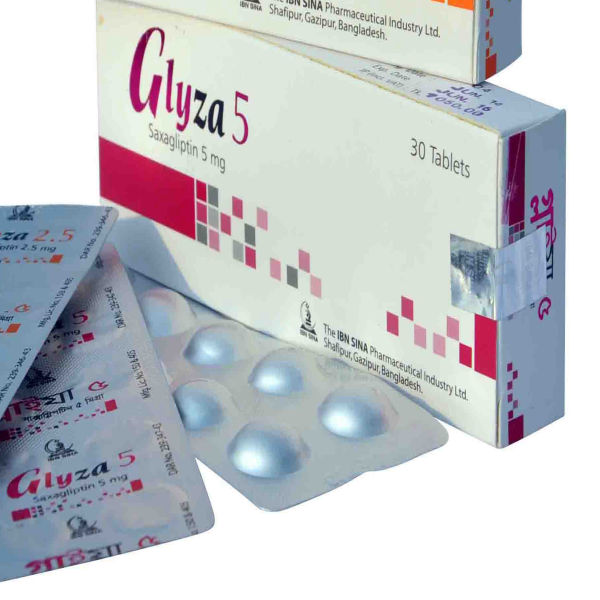
Glyza5 mg
৳ 350
Buy 15 products and get ৳ 20 discount
Description
Indications of Glyza 5 mg
Monotherapy And Combination Therapy: Glyza 5 mg is indicated as an adjunct to diet and exercise to improve glycemic control in adults with type 2 diabetes mellitusLimitation Of Use: Glyza 5 mg is not indicated for the treatment of type 1 diabetes mellitus or diabetic ketoacidosis, as it would not be effective in these settings.
Theropeutic Class
Dipeptidyl Peptidase-4 (DPP-4) inhibitor
Pharmacology
Glyza 5 mg inhibits dipeptidyl peptidase IV (DPP-IV) enzyme resulting in prolonged active incretin levels. It elevates the circulating levels of glucose-dependent insulinotropic polypeptide (GIP) and glucagon-like peptide-1 (GLP-1) which stimulates insulin secretion in pancreatic ?-cells in a glucose dependent manner. It improves glycaemic control by reducing fasting and postprandial plasma glucose concentration in patients w/ type 2 DM.
Dosage of Glyza 5 mg
Recommended Dosage: The recommended dosage of Glyza 5 mg is 2.5 mg or 5 mg once daily taken regardless of meals. Glyza 5 mg tablets must not be split or cut.Dosage In Patients With Renal Impairment: No dosage adjustment for Glyza 5 mg is recommended for patients with mild renal impairment (CrCl >50 mL/min).The dosage of Glyza 5 mg is 2.5 mg once daily (regardless of meals) for patients with moderate or severe renal impairment, or with end-stage renal disease (ESRD) requiring hemodialysis (CrCl ? 50 mL/min). Glyza 5 mg should be administered following hemodialysis. Glyza 5 mg has not been studied in patients undergoing peritoneal dialysis.Because the dosage of Glyza 5 mg should be limited to 2.5 mg based upon renal function, assessment of renal function is recommended prior to initiation of Glyza 5 mg and periodically thereafter. Renal function can be estimated from serum creatinine using the Cockcroft-Gault formula or Modification of Diet in Renal Disease formula.Dosage Adjustment With Concomitant Use Of Strong CYP3A4/5 Inhibitors: The dosage of Glyza 5 mg is 2.5 mg once daily when coadministered with strong cytochrome P450 3A4/5 (CYP3A4/5) inhibitors (e.g., ketoconazole, atazanavir, clarithromycin, indinavir, itraconazole, nefazodone, nelfinavir, ritonavir, saquinavir, and telithromycin) Concomitant Use With An Insulin Secretagogue (e.g., Sulfonylurea) Or With Insulin When Glyza 5 mg is used in combination with an insulin secretagogue (e.g., sulfonylurea) or with insulin, a lower dose of the insulin secretagogue or insulin may be required to minimize the risk of hypoglycemia
Administration of Glyza 5 mg
May be taken with or without food.
Interaction of Glyza 5 mg
Increased risk of hypoglycaemia with concomitant sulfonylureas, dose reduction may be necessary. Increased serum levels with CYP3A4/5 inhibitors (e.g. atazanavir, ketoconazole, nefazodone, ritonavir). Concomitant CYP3A4 inducers (e.g. carbamazepine, phenobarbital) may reduce the glycaemic lowering effect of Glyza 5 mg.
Contraindications
Type 1 diabetes, diabetic ketoacidosis.
Side Effects of Glyza 5 mg
The following serious adverse reactions are described below or elsewhere in the prescribing information: Pancreatitis, Heart Failure, Hypoglycemia with Concomitant Use of Sulfonylurea or Insulin, Hypersensitivity Reactions, Severe and disabling arthralgia, Bullous pemphigoid
Pregnancy & Lactation
Category B: Either animal-reproduction studies have not demonstrated a foetal risk but there are no controlled studies in pregnant women or animal-reproduction studies have shown an adverse effect (other than a decrease in fertility) that was not confirmed in controlled studies in women in the 1st trimester (and there is no evidence of a risk in later trimesters).
Precautions & Warnings
Moderate and severe renal impairment. Pregnancy and lactation.
Storage Conditions
Store between 20-25° C.
Use In Special Populations
Mild Renal Impairment: No dosage adjustment needed.Moderate to Severe including with ESRD requiring hemodialysis: 2.5 mg once daily.Hepatic Impairment No dosage adjustment.
Drug Classes
Dipeptidyl Peptidase-4 (DPP-4) inhibitor
Mode Of Action
Glyza 5 mg inhibits dipeptidyl peptidase IV (DPP-IV) enzyme resulting in prolonged active incretin levels. It elevates the circulating levels of glucose-dependent insulinotropic polypeptide (GIP) and glucagon-like peptide-1 (GLP-1) which stimulates insulin secretion in pancreatic ?-cells in a glucose dependent manner. It improves glycaemic control by reducing fasting and postprandial plasma glucose concentration in patients w/ type 2 DM.
Pregnancy
Category B: Either animal-reproduction studies have not demonstrated a foetal risk but there are no controlled studies in pregnant women or animal-reproduction studies have shown an adverse effect (other than a decrease in fertility) that was not confirmed in controlled studies in women in the 1st trimester (and there is no evidence of a risk in later trimesters).
Pediatric Uses
Mild Renal Impairment: No dosage adjustment needed.Moderate to Severe including with ESRD requiring hemodialysis: 2.5 mg once daily.Hepatic Impairment No dosage adjustment.


Reviews
There are no reviews yet.