
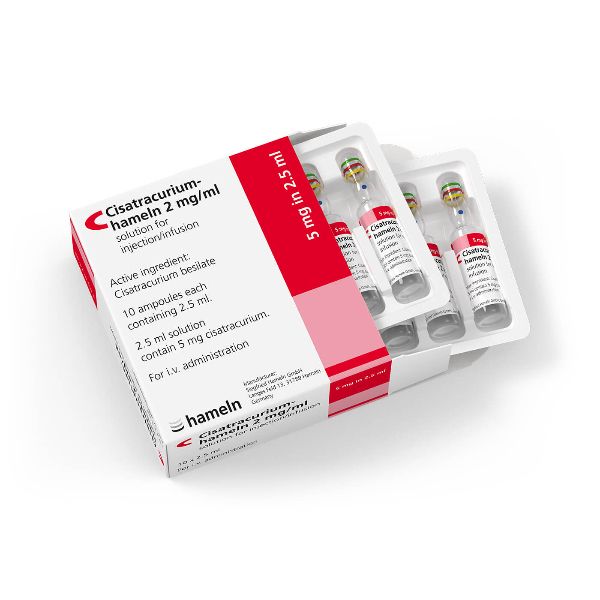
Cisatracurium Hameln IV Infusion 5ml
৳ 700
Storage Conditions
Buy 15 products and get ৳ 20 discount
Description
Indications
Dosage & Administration
Children: Initial Doses: The recommended dose of Cisatracurium for children 2 to 12 years of age is 0.10-0.15 mg/kg administered over 5 to 10 seconds during either halothane or opioid anesthesia. When administered during stable opioid/nitrous oxide/oxygen anesthesia, 0.10 mg/kg Cisatracurium produces maximum neuromuscular block in an average of 2.8 minutes (range: 1.8 to 6.7 minutes) and clinically effective block for 28 minutes (range: 21 to 38 minutes). When administered during stable opioid/nitrous oxide/oxygen anesthesia, 0.15 mg/kg Cisatracurium produces maximum neuromuscular block in about 3.0 minutes (range: 1.5 to 8.0 minutes) and clinically effective block (time to 25% recovery) for 36 minutes (range: 29 to 46 minutes).
Infants: Initial Doses: The recommended dose of Cisatracurium for intubation of infants 1 month to 23 months is 0.15 mg/kg administered over 5 to 10 seconds during either halothane or opioid anesthesia. When administered during stable opioid/nitrous oxide/oxygen anesthesia, 0.15 mg/kg Cisatracurium produces maximum neuromuscular block in about 2.0 minutes (range: 1.3 to 3.4 minutes) and clinically effective block (time to 25% recovery) for about 43 minutes (range: 34 to 58 minutes).
Interaction
The use of Cisatracurium Hameln before succinylcholine to attenuate some of the side effects of succinylcholine has not been studied. Although not studied systematically in clinical trials, no drug interactions were observed when vecuronium, pancuronium, or atracurium were administered following varying degrees of recovery from single doses or infusions of Cisatracurium Hameln. Isoflurane or enflurane administered with nitrous oxide/oxygen to achieve 1.25 MAC may prolong the clinically effective duration of action of initial and maintenance doses of Cisatracurium Hameln and decrease the required infusion rate of Cisatracurium Hameln. The magnitude of these effects may depend on the duration of administration of the volatile agents. Fifteen to 30 minutes of exposure to 1.25 MAC isoflurane or enflurane had minimal effects on the duration of action of initial doses of Cisatracurium Hameln and therefore, no adjustment to the initial dose should be necessary when Cisatracurium Hameln is administered shortly after initiation of volatile agents. In long surgical procedures during enflurane or isoflurane anesthesia, less frequent maintenance dosing, lower maintenance doses, or reduced infusion rates of Cisatracurium Hameln may be necessary. The average infusion rate requirement may be decreased by as much as 30% to 40%. In clinical studies propofol had no effect on the duration of action or dosing requirements for Cisatracurium Hameln. Other drugs which may enhance the neuromuscular blocking action of nondepolarizing agents such as Cisatracurium Hameln include certain antibiotics (e.g., aminoglycosides, tetracyclines, bacitracin, polymyxins, lincomycin, clindamycin, colistin, and sodium colistemethate), magnesium salts, lithium, local anesthetics, procainamide, and quinidine. Resistance to the neuromuscular blocking action of nondepolarizing neuromuscular blocking agents has been demonstrated in patients chronically administered phenytoin or carbamazepine. While the effects of chronic phenytoin or carbamazepine therapy on the action of Cisatracurium Hameln are unknown, slightly shorter durations of neuromuscular block may be anticipated and infusion rate requirements may be higher.
Contraindications
Side Effects
Allergic reactions (affects less than 1 in 10,000 people)
- sudden wheeziness, chest pain or chest tightness
- swelling of your eyelids, face, lips, mouth or tongue
- a lumpy skin rash anywhere on your body
- a collapse and shock.
Common (affects less than 1 in 10 people)
- decrease in heart rate
- decrease in blood pressure.
Uncommon (affects less than 1 in 100 people)
- a rash or redness of your skin
- wheezing or coughing.
Very rare (affects less than 1 in 10,000 people)
- weak or aching muscles.


Reviews
There are no reviews yet.