
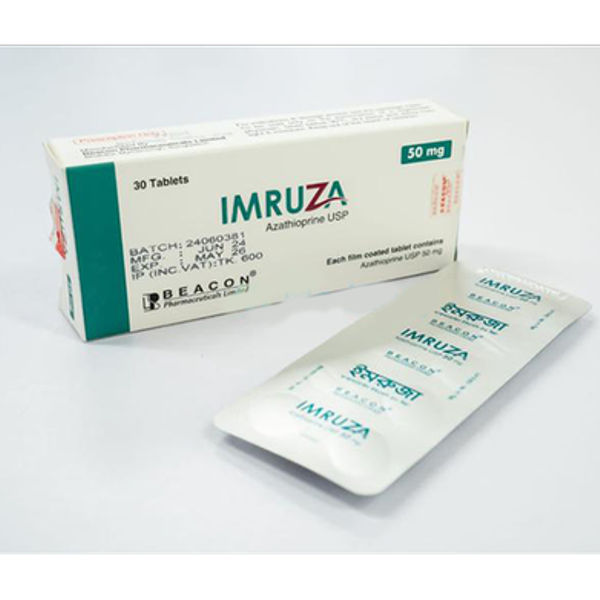
Imruza 50mg
৳ 20
Interaction
Neuromuscular blocking agents: There is considerable variation in the potency of interaction of Succinylcholine & tubocurarine with Imruza.
Anticoagulants: Inhibits the effect of the anticoagulant of warfarin, when administered with Imruza, has been reported.
Cytostatic/myelosuppressive agents: Where possible, concomitant administration of cytostatic drugs, or drugs which may have a myelosuppressive effect, such as penicillamine, should be avoided.
Methotrexate: When Imruza is administered concomitantly with high dose methotrexate, the dose should be adjusted to maintain a suitable white blood cell count.
Vaccines: The immunosuppressive activity of Imruza could result in an atypical and potentially deleterious response to live vaccines and Imruza therapy is contraindicated on theoretical grounds. A diminished response to killed vaccines is likely and such a response to hepatitis B vaccine has been observed among patients treated with a combination of Imruza and corticosteroids.
Ribavirin: Severe myelosuppression has been reported following concomitant administration of Imruza and ribavirin; therefore co-administration is not advised.
Other interactions: There is in vitro and in vivo evidence that aminosalicylate derivatives (e.g. olsalazine, mesalazine or sulphasalazine) inhibit the TPMT enzyme. Therefore, lower doses of Imruza may need to be considered.
Contraindications
Side Effects
Infections and infestations: Very common: viral, fungal and bacterial infections in transplant patients receiving Imruza in combination with other immunosuppressants
Neoplasms benign, malignant and unspecified (incl cysts and polyps): Rare: neoplasms including lymphoproliferative disorders, skin cancers (melanomas and non-melanomas), sarcomas (Kaposi’s and non-Kaposi’s) and uterine cervical cancer in situ, acute myloid leukaemia and myelodysplasia
Blood and lymphatic system disorders: Very common: depression of bone marrow function; leucopenia. Common: thrombocytopenia
Immune system disorders:Uncommon: hypersensitivity reactions
Respiratory, thoracic and mediastinal disorders: Very rare
Gastrointestinal disorders: Common: nausea
Pregnancy & Lactation
Mutagenicity: Chromosomal abnormalities, which disappear with time, have been demonstrated in lymphocytes from the offspring of patients treated with azathioprine. Except in extremely rare cases, no overt physical evidence of abnormality has been observed in the offspring of patients treated with azathioprine. Azathioprine and long-wave ultraviolet light have been shown to have a synergistic clastogenic effect in patients treated with azathioprine for a range of disorders
Fertility: The specific effect of azathioprine therapy on human fertility is unknown.
Pregnancy: Substantial transplacental and trans amniotic transmission of azathioprine and its metabolites from the mother to the fetus has been shown to occur. Pregnancy Category D. Azathioprine should not be given to patients who are pregnant or likely to become pregnant in the near future without careful assessment of risk versus benefits. Evidence of the teratogenicity of azathioprine in man is equivocal. As with all cytotoxic chemotherapy, adequate contraceptive precautions should be advised when either partner is receiving azathioprine.
Women of childbearing potential/contraception in men and women: Due to the genotoxic potential of azathioprine, women of childbearing potential should use effective contraceptive measures while being treated with azathioprine and for one month following completion of treatment. Men are recommended to use effective contraceptive measures and to not father a child while receiving azathioprine and for three months following the completion of treatment.
Lactation: It is recommended that mothers receiving azathioprine should not breastfeed. 6-Mercaptopurine has been identified in the colostrum and breast milk of women receiving azathioprine treatment
Buy 15 products and get ৳ 20 discount
Description
Indications
Imruza, combination with corticosteroids and/or other immunosuppressive agents and procedures, is indicated to enhance the survival of organ transplants, such as renal transplants, cardiac transplants, and hepatic transplants. It also reduces the corticosteroid requirements of renal transplant recipients.
Imruza is indicated for the treatment of moderate to severe inflammatory bowel disease (IBD) (Crohn’s disease or ulcerative colitis) in patients in whom corticosteroid therapy is required, in patients who cannot tolerate corticosteroid therapy, or in patients whose disease is refractory to other standard first line therapy.
Imruza either alone or more usually in combination with corticosteroids and/or other medicinal products and procedures, has been used with clinical benefit (which may include reduction of dosage or discontinuation of corticosteroids) in a proportion of patients suffering from the following:
- Severe active rheumatoid arthritis;
- Systemic lupus erythematosus;
- Dermatomyositis and polymyositis;
- Auto-immune chronic active hepatitis;
- Pemphigus vulgaris
- Polyarteritis nodosa;
- Auto-immune haemolytic anaemia;
- Chronic refractory idiopathic thrombocytopenic purpura
-
Pharmacology
Azathioprine is an immunosuppressive antimetabolite, chemically 6-[(1-methyl-4-nitro-1H-imidazol-5-yl)thio]-1H-purine. It is an imidazolyl derivative of 6-mercaptopurine and many of its biological effects are similar to those of the parent compound.Azathioprine is an imidazole derivative of 6-mercaptopurine (6-MP). It is rapidly broken down in vivo into 6-MP and amethylnitroimidazole moiety. The 6-MP readily crosses cell membranes and is converted intracellularly into a number of purine thioanalogues, which include the main active nucleotide, thioinosinic acid. The rate of conversion varies from one person to another. Nucleotides do not traverse cell membranes and therefore do not circulate in body fluids. Irrespective of whether it is given directly or is derived in vivo from azathioprine, 6-MP is eliminated mainly as the inactive oxidised metabolite thiouric acid. This oxidation is brought about by xanthine oxidase, an enzyme that is inhibited by allopurinol. The activity of the methylnitroimidazole moiety has not been defined clearly. However, in several systems it appears to modify the activity of azathioprine as compared with that of 6-MP. Determination of plasma concentrations of azathioprine or 6-MP have no prognostic value as regards effectiveness or toxicity of these compounds.
Because of these mechanisms, the therapeutic effect of azathioprine may be evident only after several weeks or months of treatment. Azathioprine appears to be well absorbed from the upper gastro-intestinal tract. Plasma levels of azathioprine and 6-mercaptopurine do not correlate well with the therapeutic efficacy or toxicity of azathioprine.
Absorption: Azathioprine is well absorbed following oral administration. Although there are no food effect studies with azathioprine, pharmacokinetic studies with 6-mercaptopurine have been conducted that are relevant to azathioprine. The mean relative bioavailability of 6-mercaptopurine was approximately 27% lower following administration with food and milk compared to an overnight fast. 6-mercaptopurine is not stable in milk due to the presence of xanthine oxidase (30% degradation within 30 minutes). Azathioprine may be taken with food or on an empty stomach, but patients should standardise the method of administration. The dose should not be taken with milk or dairy products.
After oral administration of [35S]-azathioprine, the maximum plasma radioactivity occurs at 1-2 hours and decays with a half-life of 4-6 hours. This is not an estimate of the half-life of azathioprine itself, but reflects the elimination from plasma of azathioprine and the [35S]-containing metabolites of the drug.
Azathioprine is principally excreted as 6-thiouric uric acid in the urine. 1-methyl-4-nitro-5-thioimidazole has also been detected in urine as a minor excretory product. A small proportion of the drug may be cleaved between the S atom and the purine ring. Only a small amount of the dose of azathioprine administered is excreted unmetabolised in the urine.
Biotransformation: Thiopurine S-Methyl Transferase (TPMT): TPMT activity is inversely related to red blood cell 6-mercaptopurine derived thioguanine nucleotide concentration, with higher thioguanine nucleotide concentrations resulting in greater reductions in white blood cell and neutrophil counts. Individuals with TPMT deficiency develop very high cytotoxic thioguanine nucleotide concentrations.
Dosage
Transplants:- Depending on the immunosuppressive regimen employed, a dosage of up to 5mg/kg body weight/day may be given orally or intravenously on the first day of therapy.
- Maintenance dosage should range from 1 to 4mg/kg body weight/day and must be adjusted according to clinical requirements and haematological tolerance.
- Evidence indicates that azathioprine therapy should be maintained indefinitely, even if only low doses are necessary, because of the risk of graft rejection.
Dosage in Other indications:
- In general, the starting dosage is 1 to 3mg/kg body weight/day, and should be adjusted, within these limits, depending on the clinical response (which may not be evident for weeks or months) and haematological tolerance.
- When the therapeutic response is evident, consideration should be given to reducing the maintenance dosage to the lowest level compatible with the maintenance of that response. If no improvement occurs in the patient’s condition within three months, consideration should be given to withdrawing azathioprine. However, for patients with IBD, a treatment duration of at least twelve months should be considered and a response to treatment may not be clinically apparent until after three to four months of treatment.
- The maintenance dosage required may range from less than 1mg/kg body weight/day to 3mg/kg body weight/day, depending on the clinical condition being treated and the individual patient response, including haematological tolerance.
Overweight children: Children considered to be overweight may require doses at the higher end of the dose range and therefore close monitoring of response to treatment is recommended.
Elderly: There is limited experience of the administration of azathioprine to elderly patients. Although the available data do not provide evidence that the incidence of side effects among elderly patients is higher than that among other patients treated with azathioprine, it is recommended that the dosages used should be at the lower end of the range.
Renal impairment: In patients with renal insufficiency, consideration should be given to reducing the dosage.
Hepatic impairment: In patients with hepatic insufficiency, consideration should be given to reducing the dosage.
Administration
For oral use. Azathioprine should be taken at least 1 hour before or 2 hours after milk or dairy products


Reviews
There are no reviews yet.